Number Needed to Treat and Number Needed to Harm
Baseline Risk, Outcome Choice, and Benefit Versus Harm
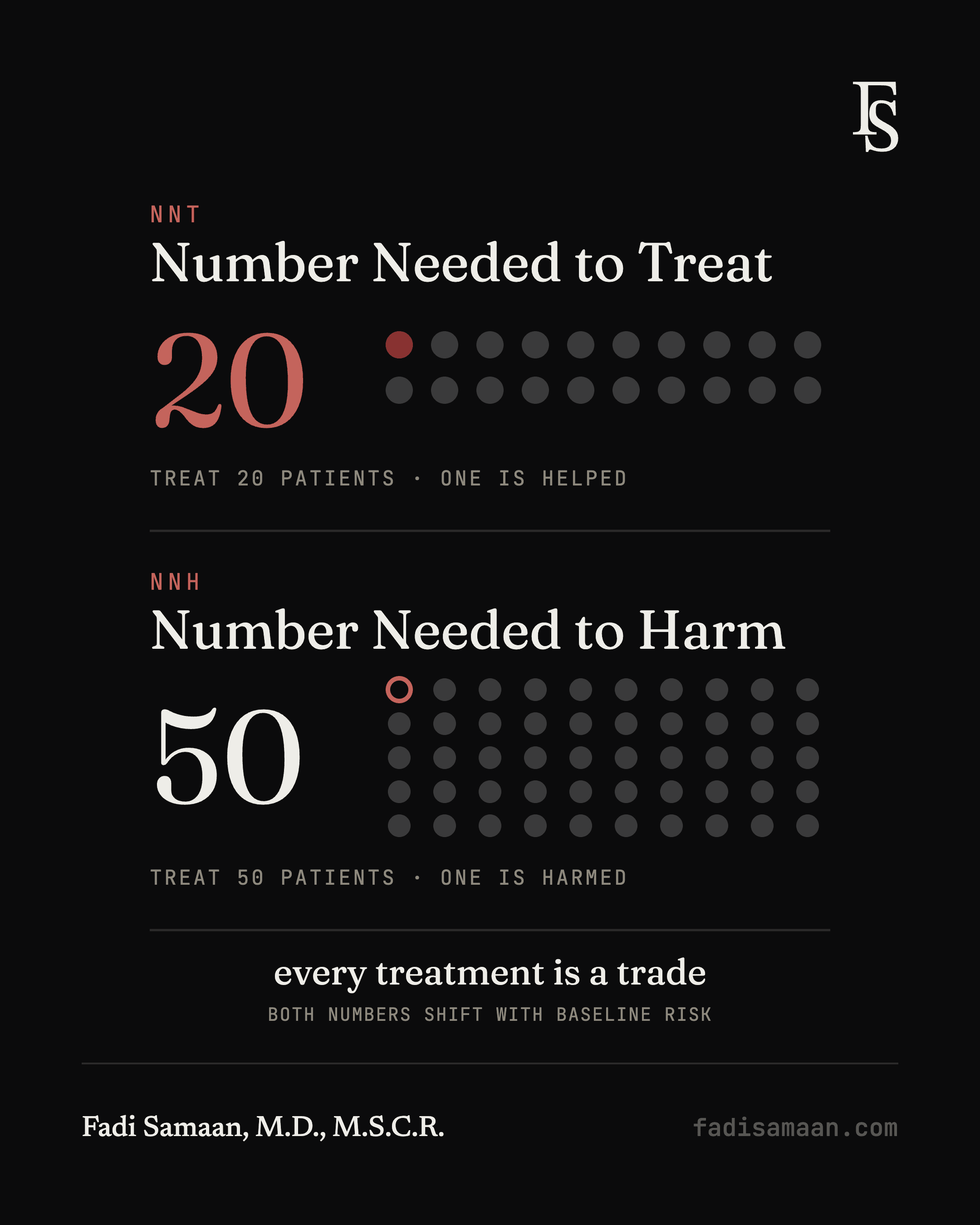
What NNT actually means
Start with the absolute risk reduction, the plain difference between how often an outcome happens without treatment and how often it happens with treatment. If 20 percent of untreated patients have an event and 15 percent of treated patients have it, the absolute risk reduction is 5 percentage points.
The number needed to treat, or NNT, is simply 1 divided by that absolute risk reduction. In this example, 1 divided by 0.05 gives an NNT of 20, meaning 20 patients need to receive the treatment for one additional patient to avoid the event who otherwise would not have. A smaller NNT means a more effective treatment, since fewer patients need to be treated to produce one extra benefit.
Number needed to harm, or NNH, works the same way in the other direction, built from the absolute risk increase in some adverse event. If an adverse effect occurs in 2 percent of untreated patients and 5 percent of treated patients, the absolute risk increase is 3 percentage points, and 1 divided by 0.03 gives an NNH of about 33. A larger NNH means a safer treatment, since more patients need to be treated before one extra harm shows up.
Why the same drug can have an NNT of 10 and also 200
NNT is often treated as though it were a fixed property of a drug, printed once on a label and true everywhere. It is not. NNT depends heavily on the baseline risk of the population being treated, even when the treatment's relative effect stays exactly the same.
Suppose a treatment reduces relative risk by 25 percent in every population it is given to. In a high risk population with a baseline event rate of 40 percent, that treatment lowers the rate to 30 percent, an absolute risk reduction of 10 percentage points and an NNT of 10. In a low risk population with a baseline event rate of only 4 percent, the identical 25 percent relative reduction lowers the rate to 3 percent, an absolute risk reduction of just 1 percentage point and an NNT of 100. The exact same drug, the exact same relative benefit, but a tenfold difference in how many patients need to be treated depending entirely on who is being treated.
The outcome being counted matters just as much. The NNT for a drug to prevent one heart attack and the NNT for the same drug to prevent one death are calculated from two different absolute risk reductions and rarely match. A single NNT quoted without saying which population and which outcome it came from is an incomplete number.
Weighing benefit against harm
Once both numbers exist, the temptation is to simply compare them, treating a lower NNH than NNT as a warning sign. That comparison only makes sense when the benefit and the harm are similarly serious. An NNT of 20 to prevent a stroke can still make a treatment clearly worthwhile even against an NNH of 15 for mild, temporary nausea, because preventing a stroke and causing brief nausea are not equivalent outcomes. The raw counts only tell part of the story, the severity of what is being prevented has to be weighed against the severity of what is being risked before either number means much on its own.
NNT and NNH are not fixed properties of a drug. They depend on who is being treated, what outcome is being counted, and what the benefit is being weighed against.
Key Takeaways
NNT is 1 divided by the absolute risk reduction; NNH is 1 divided by the absolute risk increase.
A smaller NNT means a more effective treatment, while a larger NNH means a safer one.
NNT depends heavily on the baseline risk of the population being treated, not just on the treatment's relative effect.
The same drug can have meaningfully different NNTs depending on which outcome is being counted.
Comparing NNT and NNH honestly requires weighing the severity of the benefit against the severity of the harm, not just the numbers themselves.
Up Next:
Next, we will look at the different types of regression, linear, logistic, and Cox among them, and how to tell which one a given clinical question actually calls for.